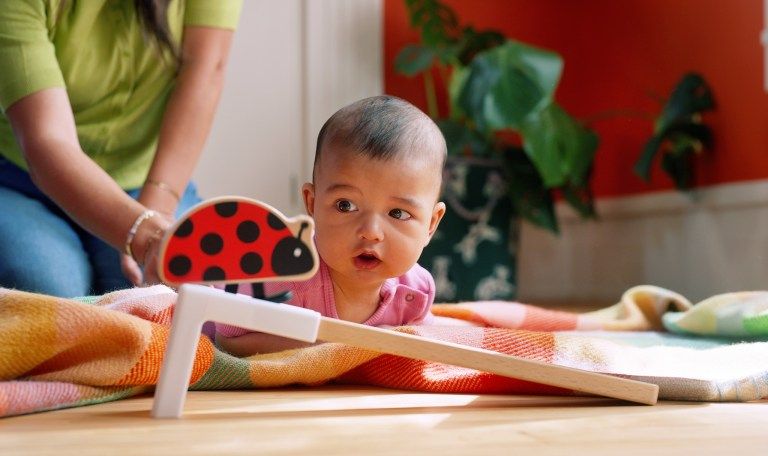
Have you heard the buzz about the Look at Me Ladybug? A new addition to The Looker Play Kit for weeks 0 to 12, this wooden plaything has quickly become a favorite for newborn play that ages up.
With a gentle tap, the Ladybug click-clacks down its ramp, capturing your baby’s attention with both sound and motion. The bold red color with black spots is designed for newborn vision—red is one of the first colors babies can distinguish, and the high-contrast pattern is easy for their developing eyes to focus on.
This is the beginning of visual and auditory tracking—when your baby uses their eyes and ears together to follow a moving object. And when the Ladybug goes down the ramp again and again during tummy time, your baby is motivated to keep lifting their head, building the upper back and neck strength they’ll need for future motor skills.
Around 4 to 6 weeks: newborn tummy time and early visual tracking
At this stage, your baby has practiced focusing their eyes, holding a steady gaze, and staying alert for short periods. Start by placing the ramp on a firm, level surface. Then, roll your baby into tummy time, about 8 to 12 inches away. Head lifting is hard work—keep play sessions short at first.
- Place the ramp within your baby’s line of sight during tummy time.
- Keep early sessions to two to five trips of the Ladybug down the ramp.
- Vary positions: side-lying, back-lying, upright in your arms, or tummy time on your lap.
Around 6 to 12 weeks: smoother tracking and longer head lifting
As your baby’s vision improves, they’ll begin to watch the Ladybug travel all the way down the ramp. Their visual tracking will start to be less jumpy, as the neural pathways responsible for managing eye movements grow stronger.
Around 2 to 3 months: turning their head to follow movement
Now that your baby is getting stronger in tummy time, they may begin turning their head to follow the Ladybug. This is an important integration of systems—their visual and vestibular sensory systems are beginning to work together with their eye and neck muscles.
Babies tend to focus longer when an object or person behaves differently than expected—a concept sometimes called the violation of expectation.
Around 3 to 4 months: recognizing patterns and anticipating what comes next
At this stage, your baby may begin to anticipate where the Ladybug will go next or show excitement by moving their body or making sounds. This is a sign that your baby is starting to make sense of patterns, laying the groundwork for later learning and problem-solving.